
Cloud-native news distribution designed for fast, reliable editorial decisions.
Experience a next‑generation, cloud‑native workflow that moves live and near‑live video through the distribution chain in seconds, using the Time‑Addressable Media Store (TAMS) API and AWS CNAP tools. It eliminates file transfers and duplicated storage, reduces fast‑turnaround costs, and gives publishers instant access to verified footage.
Combined with Reuters Connect and Reuters Live integrated AI‑timecoded transcripts, scene lists, and LPX‑compliant live metadata, helping editors find, clip and publish faster across platforms.
What a TAMs workflow can do for your business:

Speed
to air
What used to take two hours can be done in seconds, thanks to parallel segment transfers and instantaneous metadata updates.

Lower total cost of ownership
AWS cost modelling suggests significant cost reduction for fast turnaround workflows.

No duplicate storage
Real time access across organizations without file transfers or duplicated storage.

Operational
scale
The TAMS approach is cloud-elastic and interoperable, supporting live and file workflows via an open API.
Why TAMS Matters
Real Time Access for Live Workflows
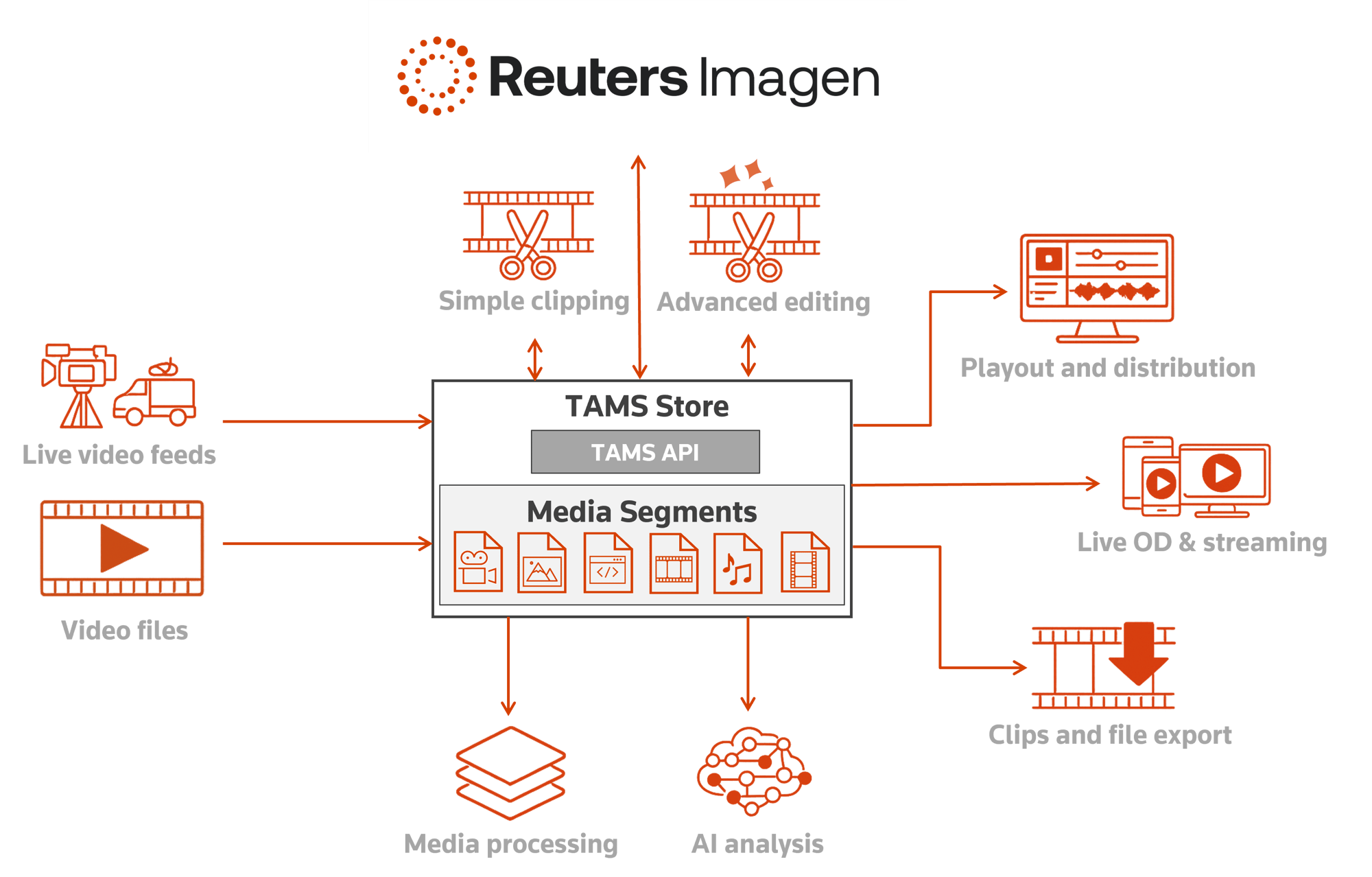
Capture live media in small segments registered against a shared timeline, so producers can share with partners without transferring whole recordings, and partners can write edits back by referencing the original segments.
Faster Production and Publishing
Because segments are time-addressable, teams can instantly find the exact moment they need and move from live-to-clip-to-publish faster, without waiting for heavyweight file handling.
Effortless scale and smarter storage footprint
TAMS’ segment-based model supports workflows like low-value (or 'dead ice') content analysis, where identified segments can be pushed to lower-cost storage. This reduces operational drag, improves control over storage decisions and offers cost optimisation.
How it works

Capture & ingest
(live + file)
Reuters live feeds and file packages are ingested as short, time‑addressable chunks into a TAMS store (open API from BBC R&D). Latency is driven by segment size; media remains addressable by time, not file.

Cloud native collaboration
via AWS CNAP
AWS provides a serverless implementation of TAMS with “TAMS Tools,” using services such as Amazon S3 and AWS MediaConvert to enable parallel transfers and instant metadata updates.

Federation to partner newsrooms
Content moves in seconds between TAMS stores (no file copy/duplicate storage), enabling real‑time access for broadcasters and publishers globally.

Automated live metadata (LPX)
Reuters Live API is the first service to comply with the Live Production Exchange (LPX) metadata standard, enabling machine‑to‑machine scheduling and receiving of live events; fewer manual steps, faster to air.

Editorial acceleration
in Reuters Connect
Editors use AI‑timecoded transcripts and scene lists to find soundbites fast and clip directly from ongoing streams, then publish across channels.
Who it’s for



Award-winning approach that moves news faster
Reuters and AWS have won the Broadcast Tech Innovation Award for Best Innovative Use of Cloud, recognizing their pioneering collaboration on next-generation, cloud-native content distribution. First showcased at IBC 2025, the award-winning workflow enables video content to move through the broadcast chain in seconds.
Built on AWS using the TAMS API, the solution is being hailed as a game changer for how trusted news is created, distributed, and monetized worldwide.